


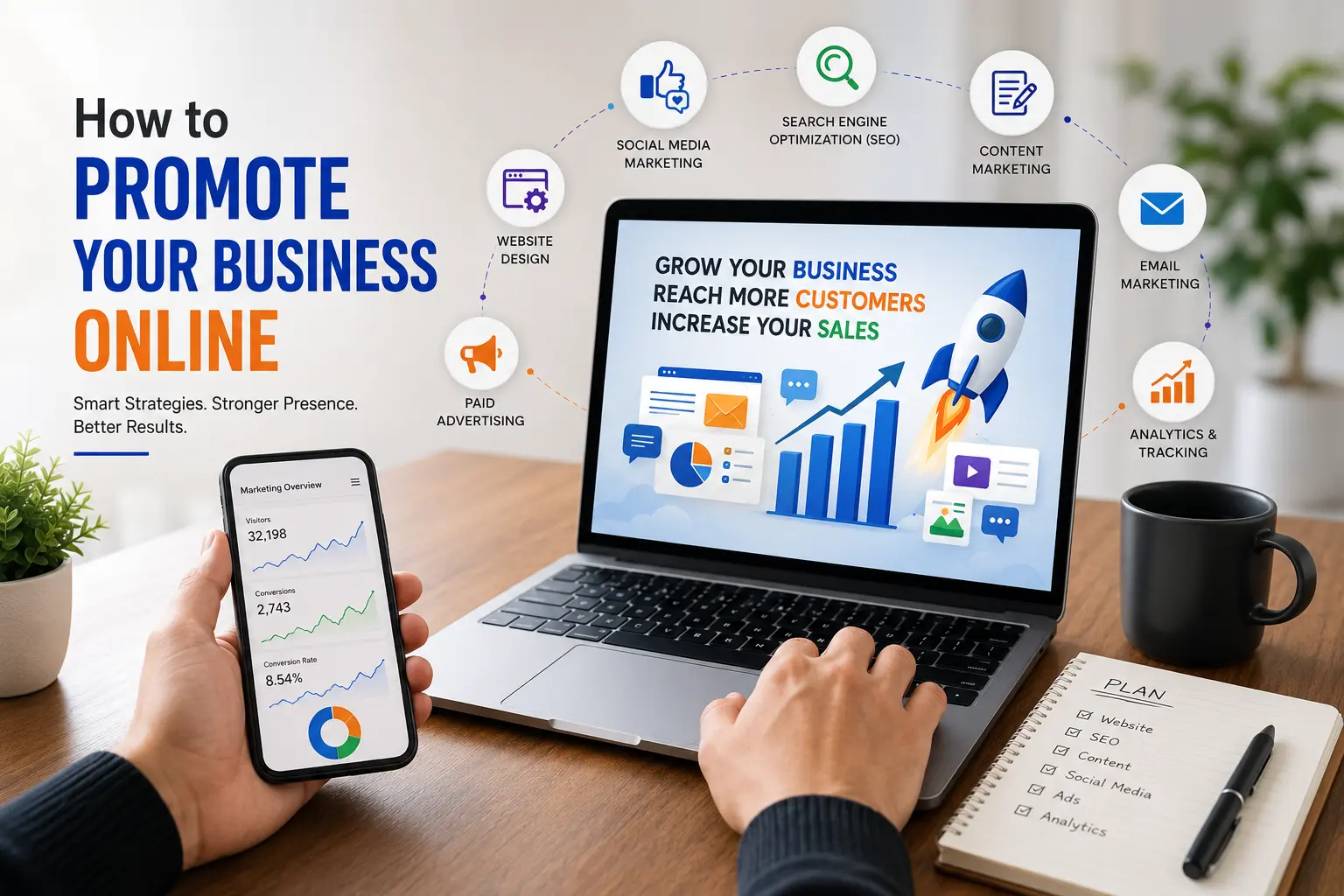
How to Promote Your Business Online: A Complete Guide for 2026
In today’s digital-first world, having a great product or service is only part of building a successful business. Your potential customers are already searching online for solutions, comparing businesses, reading reviews, watching videos, and making purchasing decisions.
That is why online business promotion has become essential for businesses of every size.
Whether you are a startup, local business, service provider, e-commerce company, or established organization, the right digital marketing strategy can help you increase brand awareness, attract qualified customers, generate leads, and grow your revenue.
In this article most effective ways to promote your business online in 2026.
1. Build a Professional Business Website
Your website is the foundation of your online presence.
Social media profiles and third-party platforms are useful, but your website gives you complete control over your brand, content, services, customer journey, and lead-generation process.
A professional business website should be:
- Mobile-friendly and responsive
- Fast-loading
- Secure with HTTPS
- Easy to navigate
- SEO-friendly
- Visually professional
- Accessible across devices
- Focused on conversions
- Easy to update
Your website should clearly explain who you are, what you offer, who you serve, and why customers should choose your business.
A strategically designed website can turn online visitors into leads and customers.
2. Optimize Your Website for Search Engines
Search Engine Optimization (SEO) helps your website appear when potential customers search for products or services related to your business.
For example, if you provide web development services, you may want your website to appear for searches such as:
- Website development company
- Business website design
- WordPress development services
- E-commerce website development
- Website development services near me
An effective SEO strategy can include:
- Keyword research
- Search-friendly content
- Optimized page titles and meta descriptions
- Proper heading structure
- Internal linking
- Image optimization
- Technical SEO
- Local SEO
- Quality backlinks
- Regular content publishing
SEO is a long-term strategy, but consistent optimization can create a valuable source of organic traffic.
3. Create Valuable Content
Content marketing is one of the most effective ways to educate your audience and build trust.
Instead of only promoting your products or services, create content that answers the questions your potential customers are asking.
You can publish:
- Blog articles
- How-to guides
- Tutorials
- Case studies
- Industry insights
- FAQs
- Videos
- Infographics
- Customer success stories
- Downloadable resources
For example, a digital marketing company could publish articles about SEO, social media marketing, website design, Google Ads, lead generation, and online branding.
Useful content can attract people before they are ready to buy and help your business become a trusted source of information.
4. Use Social Media Marketing
Social media gives businesses an opportunity to connect directly with their target audience.
Choose platforms based on where your customers actually spend their time rather than trying to maintain every social media account.
Depending on your business, you can use platforms such as:
- YouTube
- X
- Other industry-specific platforms
Share a mixture of:
- Educational content
- Product or service updates
- Behind-the-scenes content
- Customer testimonials
- Short videos
- Industry tips
- Company news
- Offers and promotions
Consistency is more important than simply posting frequently.
5. Invest in Paid Online Advertising
Organic marketing takes time. Paid advertising can help businesses reach targeted audiences more quickly.
Depending on your objectives, you can consider:
- Search advertising
- Display advertising
- Social media advertising
- Video advertising
- Remarketing campaigns
- Local advertising campaigns
Paid campaigns should have a clear objective, such as:
Generate Leads → Increase Sales → Promote a Product → Drive Website Traffic → Build Brand Awareness
Before increasing your advertising budget, monitor your campaign performance and identify which audiences, keywords, creatives, and landing pages generate the best results.
6. Focus on Local SEO
If your business serves a specific city, region, or local community, local SEO can be extremely valuable.
Make sure your business information is accurate and consistent across relevant online platforms.
Important local SEO elements include:
- Business name, address, and phone number
- Local keyword optimization
- Customer reviews
- Location-specific website pages
- Business listings
- Local content
- Accurate business categories
For example, instead of targeting only a broad phrase like “web development company,” a local company may also target searches related to its specific city or service area.
7. Build a Strong Online Reputation
Customers increasingly research a business before making a decision.
Reviews, testimonials, ratings, case studies, and customer experiences can strongly influence trust.
Encourage satisfied customers to leave genuine reviews on appropriate platforms.
You can also showcase:
- Client testimonials
- Project results
- Case studies
- Customer success stories
- Portfolio projects
- Industry certifications
- Awards and achievements
Most importantly, respond professionally to customer feedback—including negative feedback.
A strong reputation can become one of your most valuable marketing assets.
8. Use Email Marketing
Email marketing allows you to communicate directly with people who have already shown interest in your business.
You can use email campaigns to:
- Share new blog posts
- Announce new services
- Send special offers
- Welcome new subscribers
- Follow up with leads
- Share company updates
- Provide educational content
Avoid sending unnecessary promotional emails. Focus on providing useful information and creating a relationship with your audience.
9. Use Video Marketing
Video has become an important part of online marketing.
Short, informative, and engaging videos can help businesses explain complex products or services more effectively.
Consider creating:
- Product demonstrations
- Service explanations
- Tutorials
- Customer testimonials
- Frequently asked question videos
- Company introduction videos
- Behind-the-scenes videos
- Educational videos
You can publish videos on your website and relevant social platforms to reach different audiences.
10. Collaborate With Influencers and Industry Partners
You don’t always need to promote your business alone.
Partnerships with relevant creators, professionals, complementary businesses, and industry communities can help introduce your brand to new audiences.
Potential collaborations include:
- Guest blogging
- Joint webinars
- Co-branded campaigns
- Podcast appearances
- Industry interviews
- Referral partnerships
- Social media collaborations
Choose partners based on audience relevance and credibility rather than follower count alone.
11. Use Remarketing to Reconnect With Visitors
Many visitors will not become customers during their first visit.
Remarketing allows businesses to reconnect with people who previously interacted with their website or digital campaigns, subject to the relevant platform and privacy requirements.
For example, someone may visit your service page but leave without contacting you. A well-designed remarketing strategy can help bring that person back when they are ready to make a decision.
The goal is not to repeatedly show advertisements to everyone. Instead, create relevant campaigns based on user intent and the stage of the customer journey.
12. Use Analytics to Measure Your Results
Online promotion should be data-driven.
Track important metrics such as:
- Website visitors
- Traffic sources
- Leads
- Conversion rate
- Advertising performance
- Search visibility
- Social engagement
- Email performance
- Cost per lead
- Customer acquisition cost
- Return on advertising spend
These insights help you understand which marketing activities are producing results.
For example, if a blog article generates significant organic traffic but very few leads, you may need to improve its calls-to-action, internal links, or conversion journey.
13. Optimize Your Conversion Process
Getting visitors to your website is only the beginning.
Your website should make it easy for visitors to take the next step.
Use clear calls-to-action such as:
- Get a Free Quote
- Contact Us
- Book a Consultation
- Request a Demo
- Start Your Project
- Shop Now
- Download the Guide
Keep contact forms simple and ask only for information you actually need.
A well-optimized conversion process can help you generate more leads without necessarily increasing your advertising budget.
A Simple Online Promotion Strategy
If you are starting from scratch, you don’t need to implement everything at once.
A practical approach is:
Step 1: Build a professional website
Step 2: Define your target audience
Step 3: Research relevant keywords
Step 4: Optimize your website for SEO
Step 5: Create useful content regularly
Step 6: Establish a consistent social media presence
Step 7: Build your online reputation and reviews
Step 8: Test paid advertising campaigns
Step 9: Track leads and conversions
Step 10: Analyze the results and continuously improve
Common Online Marketing Mistakes to Avoid
Many businesses spend money on digital marketing without having a clear strategy.
Avoid these common mistakes:
Promoting Without Knowing Your Audience
You cannot effectively market to everyone. Define your ideal customers and understand their needs, challenges, interests, and buying behavior.
Focusing Only on Social Media
Social media is valuable, but your business should not depend entirely on a third-party platform. Your website should remain the central hub of your online presence.
Ignoring SEO
Paid advertising can generate immediate traffic, but SEO can help build sustainable organic visibility over time.
Publishing Without a Strategy
Posting random content rarely produces consistent results. Create content around your customers’ questions and business objectives.
Not Tracking Conversions
Website traffic alone does not tell you whether your marketing is successful. Track leads, sales, and other meaningful business outcomes.
Final Thoughts
Promoting your business online is not about using every available digital marketing channel. It is about choosing the right channels, understanding your audience, creating valuable experiences, and consistently measuring your results.
A strong online presence combines professional website design, SEO, content marketing, social media, paid advertising, email marketing, reputation management, analytics, and conversion optimization.
The digital landscape will continue to evolve, but one principle remains constant: businesses that provide genuine value, build trust, and make it easy for customers to connect with them are more likely to succeed online.
At Hemrix Information & Software Solutions, we help businesses build and strengthen their digital presence through professional website design and development, application development, e-commerce solutions, SEO, digital marketing, social media marketing, and customized IT solutions.
Ready to promote your business online and reach more customers? Build a digital strategy that works for your business and start growing your online presence today.
